

Arches for Reference and Sample Collections (RaSColls)
QUICK LINKS
Arches for RaSColls is currently in development. Sign up for our announcement list, join the Arches Community Forum or follow us on social media for the latest news on Arches for RaSColls.
An Arches application for managing data and sharing resources of heritage science reference and sample collections.
The conservation of significant heritage items and places requires a deep understanding of their material properties. Dozens of institutions around the world hold archives of material samples collected from heritage objects and sites, as well as reference material items, for this reason. These reference and sample collections have huge potential for research and educational purposes relating to understanding the material properties of cultural heritage.
Why Arches for RaSColls?
Using Arches for Reference and Sample Collections (“RaSColls”) will help collection managers bring the data about these collections out of paper files, spreadsheets, and bespoke systems, into a purpose-built open-source data management system. As a web-based application, Arches for RaSColls provides the ability to make the data more widely available than local systems. Arches for RaSColls leverages the robust data management capabilities of Arches, allowing for better access to and sharing of information related to these valuable resources, and increases collection managers’ ability to:
- Facilitate information sharing about heritage samples and reference items
- Draw attention to the existence of physical materials for study
- Create cost and resource efficiencies by facilitating collaboration across institutions
- Accelerate conservation research by increasing access to materials
Why Arches?
The Arches Platform was designed to manage the complex data associated with cultural heritage. As an Arches application, Arches for RaSColls incorporates the benefits and robust features of the Arches Platform, including interoperability, flexible data models, and search functionalities that facilitate the discovery and sharing of data.
What does Arches for RaSColls do?
Developed in collaboration with the Getty Conservation Institute Science Department and informed by the requirements of conservation scientists from across the field, Arches for RaSColls builds upon the functionality of Arches for Science. It is purpose-built to the requirements of the professionals who manage these collections, including:
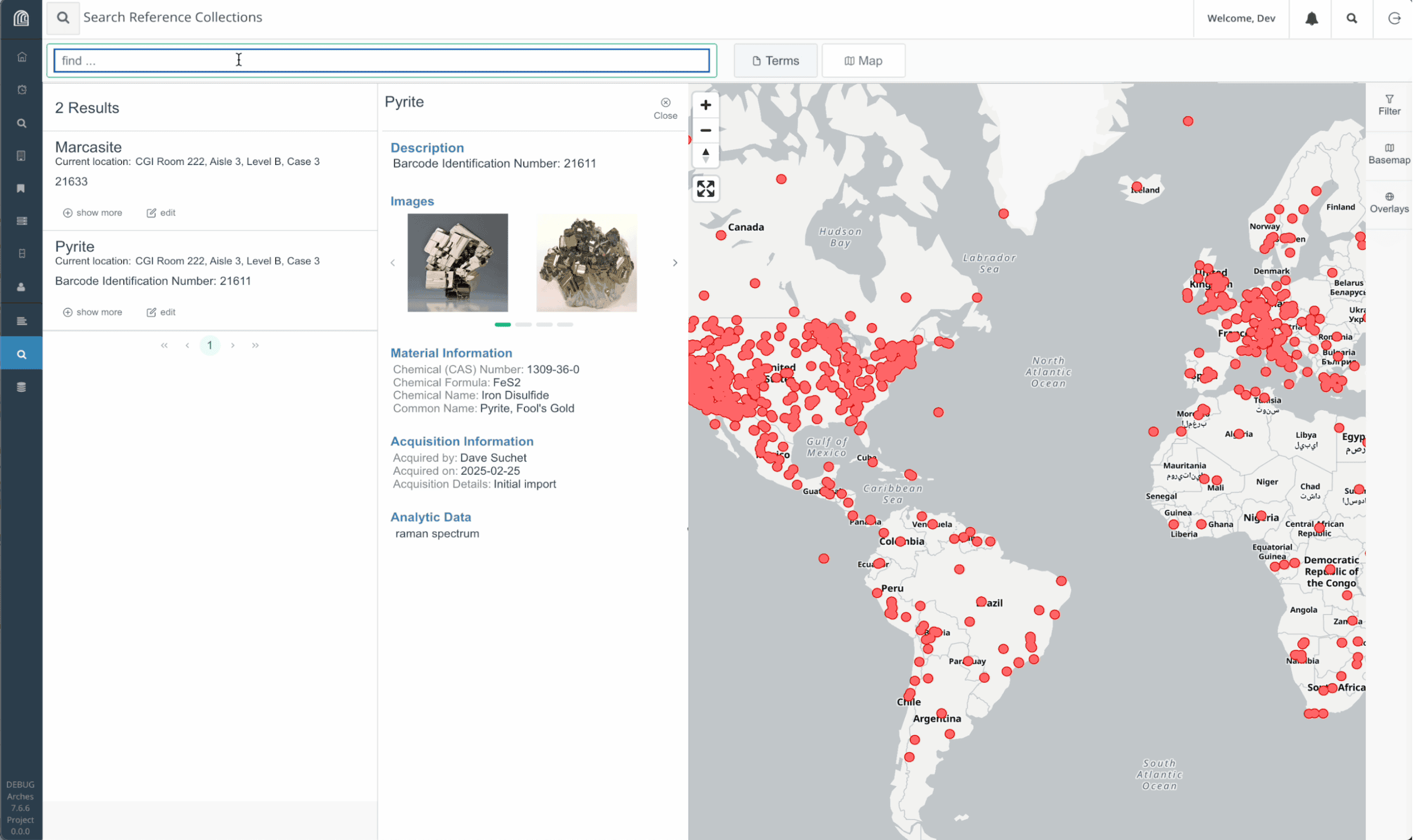
- Search and Discovery. Robust search capabilities allow for quick access to collection information, enabling effective discovery by in-house system users as well as external partners who are less familiar with navigating the managed collections.
- Customized Reporting. Populated with fields that have been customized for the data of reference and sample collections, modular reporting functionality allows for data from disparate sources to be quickly compiled into a report.
- Geographical Search. An interactive map view allows for both text-based search by location of origin, or by drawing a custom search boundary on the map.
- Standardized Data. The use of Arches allows the sometimes inconsistent data around these collections to become standardized, enhancing data stewardship and discovery capabilities.
- Analysis Data. Leveraging Arches for Science, collection objects can stay attached to the data captured in their analysis.
- Acquisition Events. Related event information around collection objects provide the ability to track the who, what, where, and when of resource acquisitions.
- Friendly IDs. The ability to generate custom identifiers allows the continuation of legacy internal standards that aren’t in conflict with UUIDs.
Roadmap
Arches for RaSColls is currently in development, with a goal of having a proof-of-concept complete by early 2027 that will be shaped by input from heritage scientists from multiple organizations. Although current focus for proof-of-concept is on RaSColls’ capacity to handle reference collection data, future iterations will include sample collection and building materials data. Visit this page and the Arches Roadmap for updates on a projected release date and what features to anticipate.
| Version | Release Date | Key Features |
|---|---|---|
| 1.0.0 | TBD |
|
| Future Features | TBD Currently Unfunded |
|
Last Updated on September 11, 2026